WordPress Powers 40% of the Web — Here’s Why It Still Rules in 2026
You probably used WordPress today without realizing it.
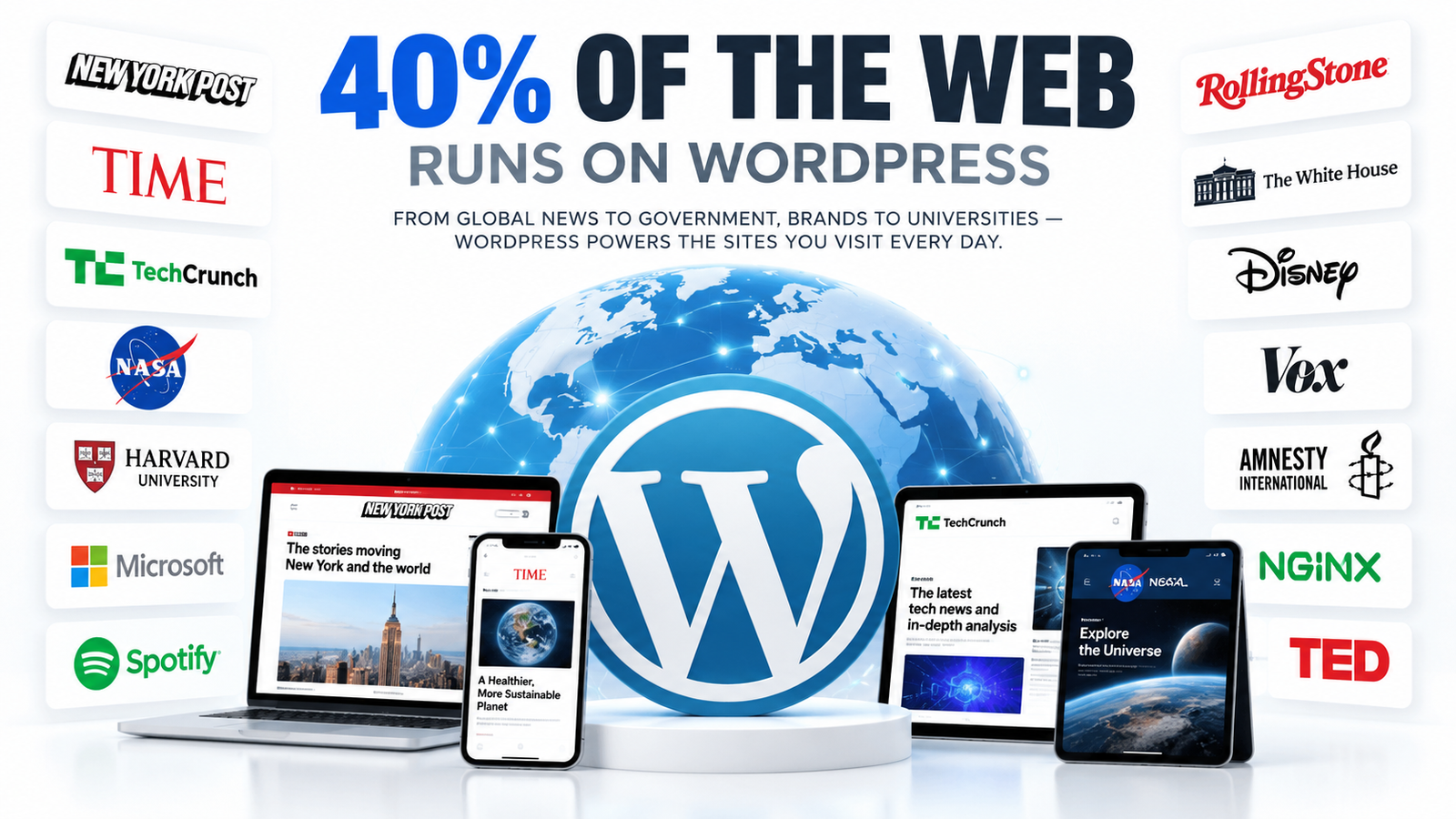
Read the New York Post? WordPress.
Checked TIME? WordPress.
Visited TechCrunch? WordPress.
Browsed NASA, Harvard, or The White House? WordPress.
And that's only the beginning.
According to W3Techs, WordPress currently powers 40.3% of all websites worldwide and 58.8% of websites where the CMS can be identified.
That's why calling WordPress “just a blogging platform” feels increasingly outdated.
The websites behind the statistic
Some of the most recognizable WordPress-powered properties include:
New York Post, TIME, TechCrunch, Rolling Stone, NASA, Harvard University, Harvard Gazette, The White House, Microsoft News, Spotify's For the Record, Vox, Global News, Amnesty International, The Intercept, Daily Kos, TVLine, Physics World, Pew Research Center, The New York Times Company, Disney Connect, TED Blog, NGINX, 9to5Mac, OMG! Ubuntu!, Ubisoft Québec, MIT Sloan Management Review, Georgia State University, U.S. Department of State, Prime Minister of India and California DMV.
WordPress.org specifically identifies New York Post as a high-traffic WordPress Enterprise publication, while its showcase also lists enterprise implementations involving Disney, CNN, Vox Media and Amnesty International.
Why does WordPress keep winning?
Because it isn't built for just one kind of website.
A creator can use it for a blog.
A business can build its company website.
A publisher can run millions of articles.
A university can manage an entire network of sites.
An enterprise can build a highly customized publishing platform.
Harvard uses WordPress Multisite. Disney uses WordPress Enterprise and Multisite. Microsoft uses WordPress for its news hub.
That's the real advantage: flexibility at almost every level.
And there's an even bigger number
WordPress isn't merely surviving while newer website platforms appear.
Among the top 1 million websites, WordPress still represents roughly half of sites with an identifiable CMS, according to W3Techs.
That's important because WordPress's dominance isn't simply caused by millions of tiny personal blogs.
It's being used by serious publishers, governments, universities, media companies and global organizations.
The bottom line
WordPress won the web by becoming something much bigger than a CMS.
It became an ecosystem.
40.3% of the web is a remarkable number. But the list of websites behind that number is even more impressive.
Next time you open a major news site, read a university publication or visit a global organization online, take a second look.
There may be a very good chance WordPress is powering it.